

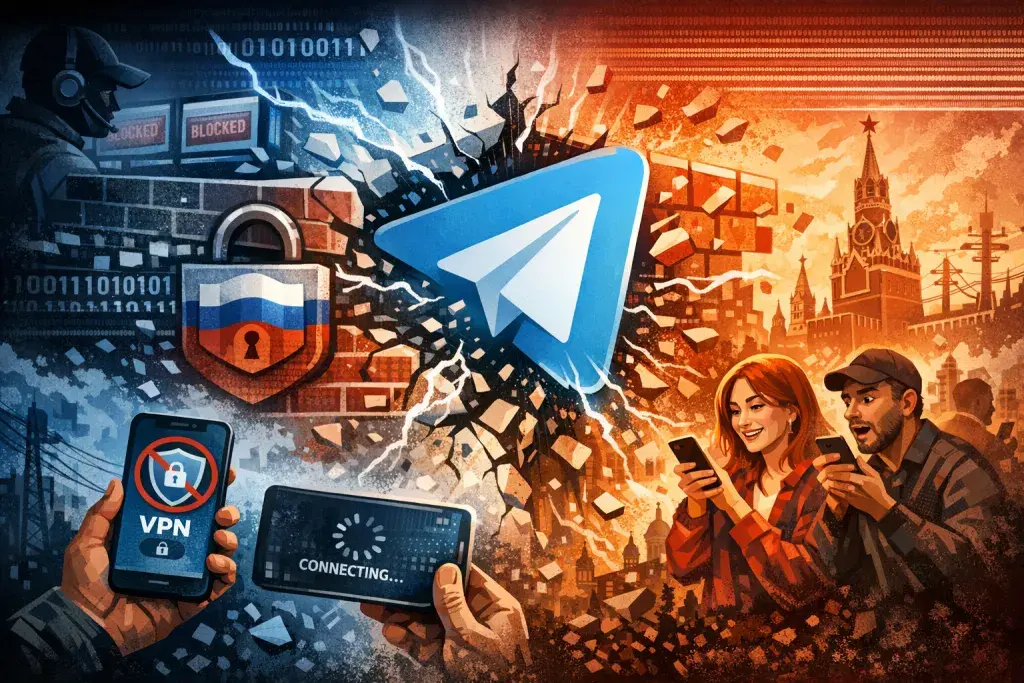
Reports from Russia on the evening of April 16 suggested that Telegram, which has been blocked by the state, was temporarily available to some users without a VPN or proxy. The reason remains unclear, but the episode drew attention because it exposed how uneven digital censorship can be in practice, even after a formal ban.
Among those who said the service was working was Ksenia Boletskaya, Yandex’s director of industry relations, who wrote that Telegram was loading for her without a VPN, including video. The Telegram channel Bbbreaking also said subscribers had reported direct access, while a Meduza poll indicated that only a small share of respondents could use the messenger without circumvention tools and a clear majority still needed a VPN or proxy.
What the reports appear to show
The available evidence points less to a full restoration of Telegram in Russia than to a partial, inconsistent opening. OONI, an international project that tracks internet interference, recorded Telegram as accessible in 11 percent of cases on April 16, a level it said was broadly comparable to the previous four days. That matters because isolated user reports can reflect real changes, but they can also capture differences between internet providers, regions, network routes, device settings, or the timing of tests.
In other words, the more plausible reading is not that the ban was lifted, but that access may have become intermittently possible for a minority of users. That kind of inconsistency is common when authorities block online platforms through technical filtering rather than a single universal switch.
Why blocked services sometimes still work
Internet blocks are often porous. Access can reappear temporarily if filtering rules are changed, if traffic is routed differently, if providers apply restrictions unevenly, or if a service alters the way its infrastructure delivers content. None of those possibilities can be confirmed from the information currently available, but all are standard features of modern network control.
Telegram has long been a difficult target for censors because messaging platforms rely on distributed infrastructure and frequent technical adjustments. Blocking a service at scale can produce gaps, especially across a large national network with many providers. That does not mean the restrictions are gone; it means enforcement may be fragmented or in flux.
The broader policy picture in Russia
Roskomnadzor blocked Telegram in Russia in March after months of tightening restrictions on one of the country’s most widely used messaging services. The move fits a broader pattern in which Russian authorities have expanded control over digital communications while also intensifying pressure on VPN services that many users rely on to reach blocked platforms.
That combination is significant. Blocking a popular messenger affects not only private communication, but also media distribution, business activity, civic discussion, and access to information. When VPN access is restricted at the same time, users face a narrowing set of practical options for staying connected to tools they have come to depend on.
What to watch next
Unless officials or the company explain what happened, the April 16 reports are likely to remain an ambiguous signal rather than a clear policy shift. The key question is whether similar openings continue, expand, or disappear. If direct access remains limited to a small minority, that would suggest temporary instability in enforcement rather than a meaningful rollback.
For users in Russia, the episode is a reminder that digital access under censorship can change by the hour. A blocked platform may suddenly work, then fail again, with little warning and no public explanation. That uncertainty has become a defining feature of the country’s internet environment.
