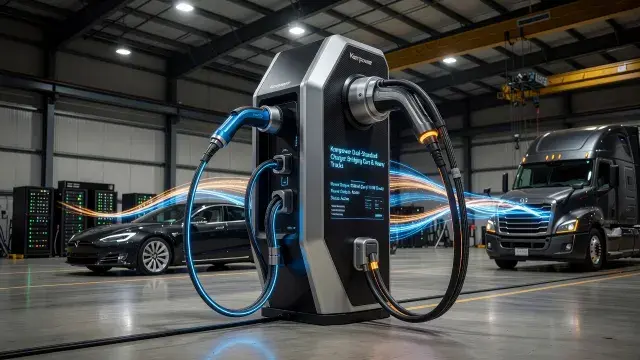
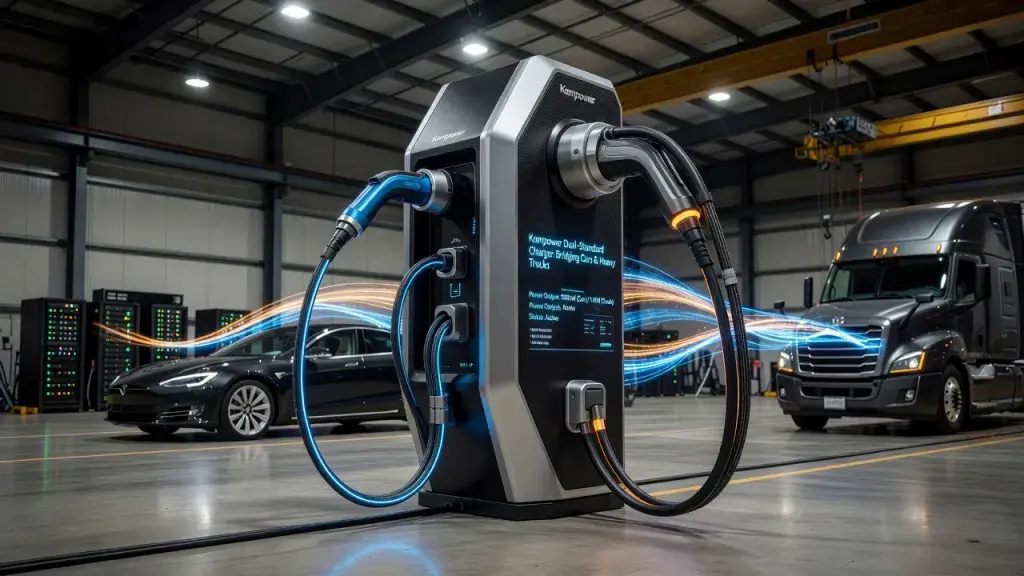
A single charging dispenser that can serve both a family sedan and an eighteen-wheeler might sound like a minor engineering footnote, but it addresses one of the thorniest problems in electric vehicle infrastructure: how to build charging networks that don't require duplicate investment for every vehicle class. Kempower, the Finnish charging hardware manufacturer, has answered that question with the Mega Satellite Flex, a new charger unveiled this week at the ACT Expo during the company's Unplug & Recharge event. It is the first Kempower dispenser capable of supporting both the established Combined Charging System (CCS) standard and the emerging Megawatt Charging System (MCS) built for heavy-duty trucks.
The timing reflects a genuine inflection point in the charging industry. CCS has been the dominant fast-charging standard for passenger EVs for years, but it was never designed for vehicles that need to replenish battery packs several times larger than a car's. MCS was developed specifically to meet that demand, pushing theoretical charging capacity well beyond what CCS connectors can handle. Much as network security has evolved to meet rising threats - the same way a VPN offering dedicated IP addresses gives users a more stable, consistent digital identity rather than juggling shared or shifting connections - charging infrastructure is now being asked to handle increasingly divergent demands from a widening range of devices, in this case vehicles with wildly different power requirements sharing the same physical sites. a VPN offering dedicated IP addresses
What the Hardware Actually Delivers
The specifications tell the story of a device built for flexibility rather than a single use case. The Mega Satellite Flex supports CCS charging up to 560 kW and MCS charging up to 1.2 MW, drawing on current ratings of up to 700 amps and 1,500 amps respectively. Cable lengths differ by standard as well, with a 5-meter cable for CCS and a shorter 2.7-meter cable for MCS connections, reflecting the different vehicle geometries each standard tends to serve. An optional payment terminal can be integrated directly into the unit, and the charger is compatible with Kempower's existing distributed charging architecture, meaning operators already running Kempower systems can add the Flex without redesigning their sites from the ground up.
The dual-standard approach also future-proofs sites for the next generation of passenger vehicles. Newer EVs built on 800-volt architectures, increasingly common among premium and performance models, can draw meaningfully higher charging speeds than older 400-volt platforms allow. A charger capable of flexing between standards and voltage levels captures that upside automatically, rather than requiring a hardware swap down the line.
Why Operators Care About One Site, Two Standards
The economics of charging infrastructure hinge on utilization. A dispenser sitting idle earns nothing, and land, grid connections, and permitting costs are substantial regardless of how much power flows through the equipment. By letting a single site serve both cars and trucks from launch, Kempower is effectively arguing that operators can achieve higher utilization rates sooner, without waiting for truck traffic to justify a dedicated MCS buildout or gambling on passenger volume alone to fill a CCS-only station. That flexibility could prove especially valuable along highway corridors where fleet operators and everyday drivers already share the same rest stops and travel patterns.
A Signal for the Road Ahead
MCS is still in its early rollout phase, and CCS will remain the practical standard for passenger vehicles for years to come. Hardware that treats the transition as a shared infrastructure problem, rather than two separate markets, suggests where the charging industry expects the puzzle to resolve. Kempower says the Mega Satellite Flex will reach North American and European markets in July 2026, giving fleet planners and site developers a concrete timeline to build around as electric trucking moves from pilot programs toward wider commercial deployment.